The Cost of Growing Apart: Modern Love at The Boardwalk
Poppy Hope Smith’s new drama avoids simple villains, offering instead a sharp, deeply human look at what happens when two good people simply grow apart.
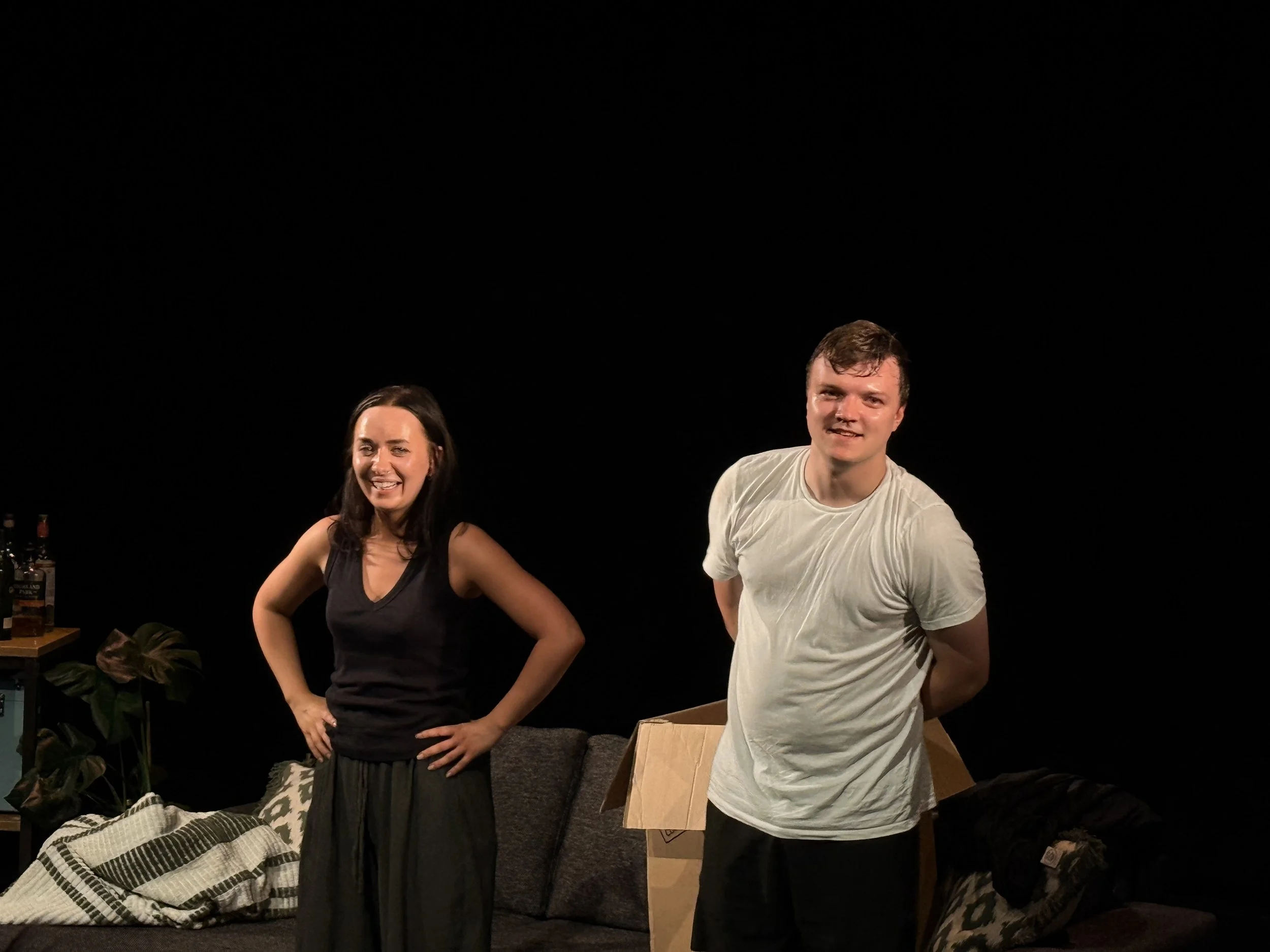
by Mikael Lee Donaldson
There is a quiet tragedy in outgrowing someone you once loved – not because of a dramatic betrayal, but because two people simply evolve into different versions of themselves. In Poppy Hope Smith’s Modern Love, directed by Steph Austin at Impact Arts' The Boardwalk, the end of a relationship becomes an insightful, messy examination of expectation versus self-discovery.
The play drops us right into the sharp end of a breakup. Early on, we are quick to judge Estelle, the one pulling the plug. She appears strong-willed and resolute, while Andrew – dominating the dialogue with needy, puppy-dog desperation – seems caught off-guard and unwilling to accept that she wants to leave, even buying an engagement ring from their joint savings without considering her feelings as a last ditch effort to save their relationship.
Yet, as the narrative ping-pongs between them, it becomes clear Estelle hasn't written off his humanity, nor is either character fundamentally wrong. Andrew is a settler; he has built a comfortable life, defined by routine, basic day-to-day existence, and the security of a partner. Estelle, however, is waking up. Terrified by the realisation that "you’re the only decision I’m stuck with," she realises she spent years following societal expectations simply because "he was there." She dreams of more.
Andrew knows something needs to change, too; Estelle just reached that truth first. Ultimately, the play argues that it isn't malicious to let go of old roles and give each other room to grow as individuals rather than a default couple.
This emotional tug-of-war is grounded by two exceptional performances. Playing Estelle, Smith grounds the show with an impressive subtlety and naturalism that draws the audience right in. You can actively watch the cogs turning behind her eyes; Smith dives deep into the character, giving Estelle remarkable psychological depth. Opposite her, Bailey Newsome brings Andrew’s chaotic, lovable, and fun energy to life with bounds of charismatic charm. Newsome navigates Andrew's shifting mindsets beautifully, capturing both his hyperactive defence mechanisms and the quiet, introspective moments when he retreats into himself.
Austin’s direction keeps the space tightly focused on this emotional friction, culminating in a devastating final flashback to the couple moving into their flat years ago. It is warm, tender, and genuinely lovely – a bittersweet landing that leaves you holding the tragic reality of how two good people can start in the exact same place and still grow entirely apart.
Modern Love is one of those gems of a play where on the surface you are presented with a simple sotry – a breakup – but are constantly thinking throughout about the relationships you have had yourself because they were expected, or right at the time, and even those moments some of us have been lucky enough to relaise that the life we’re living isn’t the life we want.
At it’s core this is play about hope, about choosing yourself, and it’s done beautifully.
Atelier 32 is an independant producing house founded in 2025 by Stephanie Austin and Poppy Hope Smith dedicated to creating and developing new theatre, television, and film for a new generation of artists. Drawing inspiration from music, art, fashion, and cinema, the company aims to marry traditional artistic legacy with contemporary voices, championing stories defined by distinct perspectives and a strong visual style. Operating under the ethos that "style and substance belong together," Atelier 32 approaches every stage of production – from early development through to the final performance – with care, intention, and precise creative execution.
Keep up to date with what they do next at: atelier32.co.uk